


Community Services Boards serve many individuals with complex needs. At times, individuals served by the CSBs may find themselves involved in the criminal justice system, after incurring criminal charges and in some cases becoming incarcerated. If you become aware that an individual you are serving has been arrested, you are encouraged to outreach the jail’s medical or mental health provider to discuss the individual’s continuity of care, determine the timeline for re-entry, and address discharge needs.
Other ways in which the CSB may be involved in care for individuals who have been charged with criminal offenses include, but are not limited to:
- Provision of court-ordered Adult Outpatient Competency to Stand Trial services
- Discharge planning from DBHDS-operated psychiatric hospitals when individuals are hospitalized upon order from a criminal court
- Discharge planning, monitoring, and reporting to the courts related to individuals found Not Guilty by Reason of Insanity
- Partnering with local courts to serve individuals ordered to participate in Behavioral Health Dockets, Veterans Dockets, or Recovery Courts
- Serving as a resource to the courts and court personnel, providing information on services and support available in the community for justice-involved individuals
- Collaborating and planning with justice partners, such as local law enforcement, the jail, judges, prosecutors, and defense attorneys on ways to divert individuals with Serious Mental Illness from the justice system into treatment

Forensic Evaluations
When the court has a question about a defendant’s mental health and how it may impact his or her current ability to participate in court, or how their mental illness may have impacted their behavior during a crime, the court will order a forensic evaluation. The most common evaluations are for Competency to Stand Trial and Mental State at the Time of the Offense, but the court may order other evaluations.
Most competency to stand trial and mental state at the time of the offense forensic evaluations are completed by private practice clinical psychologists or psychiatrists with specialized training and experience in forensic evaluation.
Sometimes the courts are not aware of who is or is not eligible to perform forensic evaluations and they may reach out to the CSBs to request that CSB staff perform the evaluation or to request help identifying a qualified evaluator. Most CSBs do not employ qualified forensic evaluators and therefore are unable to perform court ordered forensic evaluations in-house. If courts contact your CSB for assistance arranging for a forensic evaluation, please refer them to the Commissioner’s List of Approved Forensic Evaluators, where they may locate and outreach evaluators directly.
Adult Outpatient Competency Restoration
DBHDS provides training and resources for CSB Adult Outpatient Competency Restoration providers, including the Adult Outpatient Competency Restoration Manual for CSBs/BHAs. Each CSB has a designated Outpatient Restoration Coordinator, who is responsible for ensuring services are provided upon receipt of a court order. CSB Restoration Providers can reach out for training and technical assistance.
Community Services Boards are eligible to receive payment from DBHDS for outpatient restoration services that they provide. Please review the included guidelines for requesting payment through DBHDS for those services.
Materials for Restoration Providers
Restoration Session Slides
- Part 1: Your Charges (English)
- Part 2: Roles (English)
- Part 3: Working with your attorney (English)
- Part 4: Court Process (English)
- Part 5: Courtroom Behavior (English)
Restoration Video Graphic
Restoration Flash Cards
Model Court Orders for Competency Evaluation and Restoration
Model Letters from CSB to Court Regarding Restoration Services
Payment for Adult Outpatient Restoration Services through DBHDS
Forensic Admissions to DBHDS Operated Facilities
Individuals admitted to DBHDS behavioral health hospitals under a forensic status are ordered there for treatment or evaluation by a criminal court. The most common forensic admissions are for:
- emergency treatment from jail,
- forensic evaluation,
- restoration of competency to stand trial, and
- a finding of Not Guilty by Reason of Insanity.
Once DBHDS receives the court order, the Department works to admit the individual as quickly as possible. For individuals in pretrial status (i.e., not convicted), the patient will typically return to jail once the court order is fulfilled, in order to proceed with their criminal case.
If an inmate is transferred to DBHDS for inpatient evaluation or treatment, the CSB will be alerted and assigned to assist with discharge planning. It is ideal for the CSB to keep the individual’s case open, or reopen it while incarcerated, to assist with a more seamless reentry process. If your CSB has a Forensic Discharge Planning (FDP) grant, it is encouraged that the FDP staff be incorporated in the individual’s care while at DBHDS and at the point of return to and re-entry from the jail. CSBs play a vital role in bridging care between the hospitals, jails, and the community.
Behavioral Health Docket
Individuals with behavioral health disorders may be eligible to participate on a Behavioral Health Docket. These are specialized court dockets within the existing structure of Virginia’s circuit and district court system offering judicial monitoring of intensive treatment, supervision, and alternatives to traditional criminal case processing. These dockets usually require the individual to participate in mental health treatment for an extended period of time in exchange for dismissed or reduced charges or a reduction in sentence. Not all courts offer behavioral health dockets, and not everyone with a behavioral health disorder will be eligible for them. An individual’s defense attorney is usually responsible for referring the defendant to the docket.
If your CSB is interested in partnering with the court in your area to develop a behavioral health docket, please contact Jessica Peay at j.peay@dbhds.virginia.gov or Sarah Davis at Sarah.Davis@dbhds.virginia.gov.
Not Guilty by Reason of Insanity (NGRI)
The Executive Director of each Community Services Board (CSB) has designated a member of his/her staff to serve as NGRI Coordinator. The CSB NGRI Coordinator is responsible for overseeing the compliance of the CSB and the NGRI acquittee with court orders for conditional release and coordinating the provision of reports to the court in a timely fashion. They are also the point person for coordinating all NGRI cases within their catchment area. This individual will be alerted once DBHDS receives the order for outpatient temporary custody or when the person is admitted for inpatient temporary custody.
In cases where the court has authorized outpatient temporary custody evaluation, the CSB should open the acquittee to services (if not already an established client) and meet with him or her as soon as possible after notification by DBHDS. DBHDS must determine if outpatient evaluation is appropriate and may recommend to the court that the outpatient temporary custody evaluations instead occur on an inpatient basis. CSB communication with the Office of Forensic Services and the DBHDS Forensic Coordinator is essential in making that determination and for monitoring the acquittee’s progress in the community.
In cases where an individual is admitted to DBHDS for inpatient temporary custody evaluation, the CSB should provide discharge planning and NGRI coordination according to the expectations outlined in the Collaborative Discharge Protocols for CSBs and State Hospitals (Adult/Geriatric) and the NGRI Guidelines for the Management of Individuals Found Not Guilty by Reason of Insanity. If one or both of the temporary custody evaluators recommend conditional release, it’s the responsibility of the CSB to a develop conditional release plan in consultation with the treatment team and the acquittee. If committed, the CSB will be responsible for future conditional release planning.
If an acquittee is placed on conditional release, the CSB NGRI Coordinator (or designee) will be responsible for monitoring the acquittee’s compliance with court-ordered services in the Conditional Release Plan. The CSB is also responsible for reporting to DBHDS and the court regularly about the acquittee’s adherence to the Conditional Release Plan, treatment response, and if there are any modifications recommended to the plan. The CSB is also responsible for making unconditional release recommendations to the court when an acquittee meets criteria for removal of conditions.
CSB NGRI coordinators can reach out to the Office of Forensic Services or the DBHDS Facility Forensic Coordinators for additional training and technical assistance as needed.
NGRI Documents and Helpful Links
Sequential Intercept Model
The Sequential Intercept Model (SIM) shows how people with behavioral health disorders, such as mental illnesses or substance use disorders, typically move through the criminal justice system. If we understand how people move through the system, different interventions can be put into place to “intercept” or remove people from the criminal justice system and place them into appropriate behavioral health care.
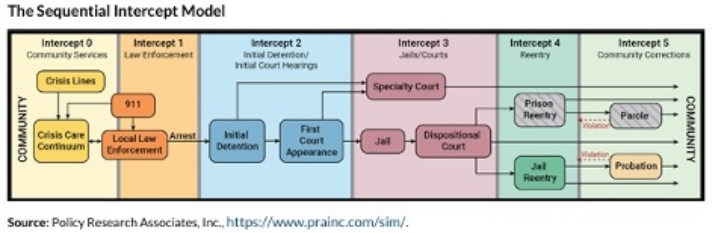
DBHDS manages funds that are distributed to CSBs to provide interventions across Intercepts. If your CSB would like more information on the Sequential Intercept Model or services across intercepts, contact Kristen A. Hudacek, Psy.D., LCP at Kristen.hudacek@dbhds.virginia.gov.
DBHDS operates and manages programs that touch various Intercepts, including:
Intercept 0: 988 Crisis Hotline
Intercept 1: Crisis Intervention Teams and Crisis Receiving Centers
Intercept 2: Magistrate or Post-Booking Diversion programs
Intercept 3: Jail Diversion programs, Behavioral Health Dockets, Forensic Evaluations, Competency to Stand Trial, and Not Guilty by Reason of Insanity.
Intercept 4: Forensic Discharge Planners
Intercept 5: DBHDS is typically not involved in criminal justice monitoring while individuals are in the community. This is done by the Department of Corrections for felony cases, or local probation for misdemeanor offenses.